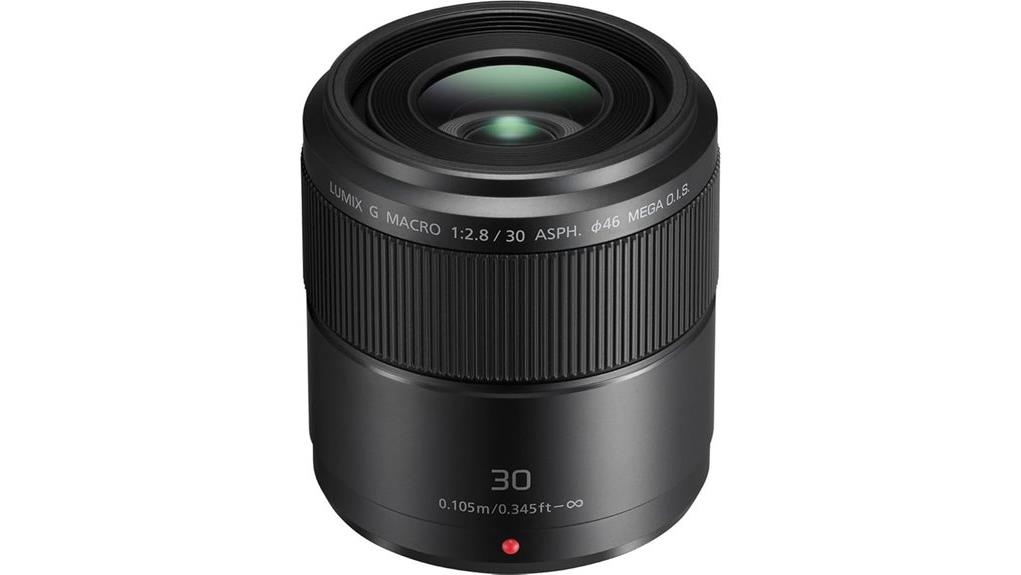
You’ll get a compact, technically refined Micro Four Thirds macro that delivers true 1:1 reproduction, excellent center-to-corner sharpness and smooth bokeh from a four-blade diaphragm. It focuses quickly with a 240 fps Drive AF and steadies handheld shots using MEGA O.I.S., though AF can struggle on low-contrast subjects and stabilization shows latency during rapid pans. Build is light with a metal mount and 46mm filter thread, and practical tips and comparisons follow if you want more.
Some Key Takeaways
- True 1:1 macro magnification offers pixel-level detail for close-up, tabletop, and product photography on Micro Four Thirds bodies.
- Nine-element/one-aspherical optical design delivers excellent central sharpness at f/2.8 and improved resolution by f/5.6.
- MEGA O.I.S. and fast 240 fps Drive AF improve handheld macro stability and rapid subject acquisition.
- Smooth, controlled bokeh with minimal chromatic aberration, though diaphragm has only four blades limiting highlight rendition.
- Compact, lightweight build with metal mount, 46mm filters, and strong center-to-corner performance; limited focal length for portraits.
Optical Performance and Macro Capability: Sharpness, Bokeh, and 1:1 Reproduction
While shooting close-ups with the Panasonic LUMIX G 30mm F2.8 Macro, you’ll notice it resolves exceptional detail edge-to-edge thanks to its 9-element/9-group design (including an aspherical element) and precise optics that deliver 1:1 reproduction on Micro Four Thirds bodies. You’ll find central resolution excellent at f/2.8, improving marginally stopped to f/5.6; measured edge sharpness remains high, minimizing falloff toward corners. Bokeh is smooth for a four-blade diaphragm, yielding controlled out-of-focus rendition that isolates subjects. You can discern fine background texture separation when working close, and chromatic aberration is well controlled by the optical formula. For those building a close-up kit, pairing dedicated macro lenses with Macro lenses improves versatility and image quality.
Autofocus, Image Stabilization, and Shooting Speed: Real-World Handling and Reliability
Because the lens combines a fast drive AF system with MEGA O.I.S., you’ll get responsive focusing and steadier handheld macro shots in typical shooting conditions. You’ll notice 240 fps Drive AF yields rapid subject acquisition with low hunting at close distances; measured autofocus reliability is high on contrast-rich targets but declines slightly in low-contrast or reflective scenes. MEGA O.I.S. reduces handshake effectively, though stabilization latency can be perceptible when panning or during immediate focus shifts. Continuous shooting at 240 FPS paired with quick AF enables capture of transient moments, but buffer and camera body processing ultimately define sustained burst performance. If you shoot on a tripod or with an L-bracket for precise framing, the added stability and convenience can noticeably improve composition and handling in macro work, especially during focus stacking with L-brackets.
Build, Size, and Mounting: Ergonomics, Filter Size, and Compatibility With Micro Four Thirds Bodies
Although compact by Micro Four Thirds standards, the Panasonic 30mm F2.8 Macro feels solid and purpose-built, with a metal mount, a friction-tuned focus ring, and a plastic barrel that balances durability and lightness for comfortable handheld use. You’ll notice a compact footprint that keeps balance favorable on smaller LUMIX G bodies, reducing front-heaviness and fatigue. The 46mm filter thread stays small and economical. Mount compatibility is native Micro Four Thirds, ensuring mechanical and electrical integration with AF, O.I.S., and exposure control. Overall ergonomics favor tactile control and predictable handling across compatible mirrorless bodies. For shooters interested in long days of handheld shooting, pairing the lens with a camera shoulder rig can further improve comfort and stability.
Use Cases, Sample Shots, and Workflow Tips: Macro, Portraits, and Close-Up Techniques With Settings
Having established how the lens sits and feels on Micro Four Thirds bodies, you can exploit its 1:1 macro capability and compact handling for precise close-up work, tabletop still lifes, and intimate environmental portraits. Use low ISO, narrow apertures (f/8–f/16) for depth in stacked macro sequences; stop to f/2.8–f/4 for portraits to isolate subjects. Rely on MEGA O.I.S. and tripod use for shutter stability. Implement lighting techniques: off-camera flash, diffusers, and continuous LEDs to control specular highlights. Employ focusing aids—focus peaking, magnified live view, and focus bracketing—to secure critical sharpness on shallow depth-of-field subjects. Consider using extension tubes when you need even greater magnification beyond the lens’s native close-focus capabilities.
Value Verdict and Buying Advice: Pros/Cons, Who Should Buy, and Alternatives to Consider
When you weigh the Panasonic LUMIX G 30mm F2.8 Macro against its peers, it stands out for delivering true 1:1 macro magnification, compact handling, and effective MEGA O.I.S., making it a technically solid choice for close-up work and everyday shooting on Micro Four Thirds bodies. You’ll appreciate sharp center-to-corner rendering, fast 240 fps AF, and lightweight ergonomics. Pros: true macro, stabilized handheld capability, strong accessory compatibility (46mm filters, close-up adapters). Cons: limited focal length for portraits, four-blade diaphragm, niche demand affects price comparison and availability trends. Buy if you value optical precision; consider 45mm or 30mm alternatives for resale value. The site Perfect Portrait Lenses also focuses on portrait-oriented optics and accessory compatibility, offering useful context for buyers looking for portrait lens options.
Some Questions Answered
Is a Lens Hood Included With the Panasonic 30MM Macro Lens?
No — a lens hood isn’t included. You’ll want alternatives: purchase Panasonic’s proprietary hood if available, look at Hood options from Third party hoods that match the 46 mm filter thread and optical profile, or use DIY solutions like a clip-on petal hood or folded card shield for flare control. You’ll get better stray-light rejection and contrast with a fitted hood, so verify clearance for macro working distances before buying.
Can This Lens Be Used for Video Autofocus Smoothness on LUMIX G Cameras?
Yes — you can use this lens for video autofocus smoothness on Lumix G cameras. You’ll get smooth focus shifts aided by the 240 fps Drive AF and MEGA O.I.S., and continuous tracking works well for slow subject motion. Expect quiet, precise focus transitions and reliable subject lock in typical lighting; very fast erratic motion may challenge tracking. Pair with camera body AF tuning for ideal smooth focus and continuous tracking performance.
What Accessories (Case/Filter Cap) Are Compatible With the 46MM Thread?
You can use any standard 46mm filters and protective caps that fit a 46mm thread. Buy slim UV, polarizer, ND, and macro-compatible close-up filters sized 46mm; choose multi-coated glass for minimal flare. For caps, use snap-on or screw-in 46mm front caps and rear caps matching the Micro Four Thirds mount. Hard cases and padded pouches sized for a 0.6 lb compact lens will protect the barrel and hood during transport.
Does the Lens Support Focus Stacking Workflows Natively?
No, it doesn’t provide native focus stacking; you’ll need to use manual focus or camera-based focus bracketing where supported. You can perform focus bracketing on compatible Lumix bodies or manually adjust focus and use focus rails for precise stepwise shifts. For best results, use consistent step sizes, a stable tripod, and software stacking post-capture. Expect to rely on external camera features or manual techniques rather than lens-integrated stacking.
Is There Weather Sealing on the H-Hs030 Body?
No — the H-HS030 body doesn’t have dedicated weather sealing. You shouldn’t expect thorough weather resistance or gasketed mount protection. Mechanically it’s a compact, precise design with MEGA O.I.S. and smooth AF, but Panasonic doesn’t list sealing details for this model. If you need splash or dust protection, use a sealed camera body plus careful handling, or choose a lens explicitly rated for weather resistance to guarantee reliable outdoor use.