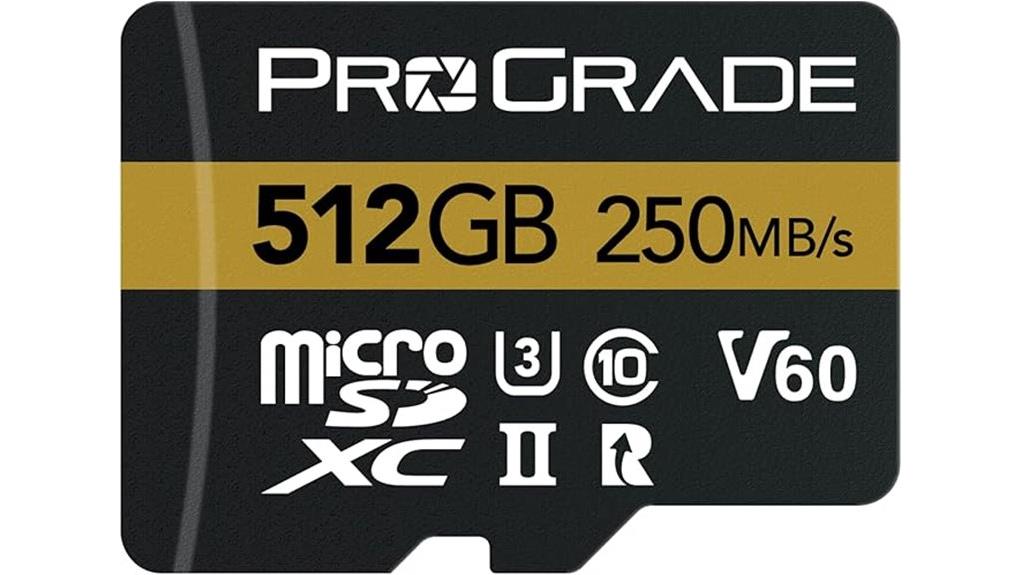
You’ll get a reliable 512GB ProGrade microSD V60 that reads up to 250 MB/s and sustains V60-class writes for long 4K shoots. Short bursts hit ~120–130 MB/s; prolonged recording settles near the 60–80 MB/s V60 floor depending on your host. It includes a hardware-backed serial number, Refresh recovery software, and an SD adapter for workflows. It’s a solid choice for pro photo/video and drones—keep going to see detailed tests, caveats, and alternatives.
Some Key Takeaways
- 512 GB microSD delivers up to 250 MB/s reads and ~120–130 MB/s short-burst writes, settling to V60 sustained rates for long recordings.
- Real-world reads reach ~230 MB/s sustained; writes drop to ~60–80 MB/s under continuous heavy load depending on host.
- V60/U3-certified performance reliably handles 4K/UHD and lengthy aerial/action sessions with brief burst buffering.
- Includes SD adapter, hardware-backed serial authentication, ProGrade Refresh software, and a 3-year warranty.
- Premium-priced but offers strong reliability, recovery tools, and anti-counterfeit features; check drone power draw and device firmware.
What the ProGrade microSDXC V60 Promises: Specs and Key Features
Although it’s compact, the ProGrade microSDXC V60 promises pro-level performance and protection for demanding workflows. You get 512 GB in a microSD form with up to 250 MB/s read and 130 MB/s write, V60 and U3 certifications, plus an SD adapter. Evaluate buffer management and power draw implications for burst shooting or drone footage; the card’s firmware updates and design aim to reduce corrupted files and manage thermal throttling under sustained loads. Hardware-backed serial authentication, ProGrade Refresh software, and a 3-year warranty round out reliability claims you can verify before committing. This makes it a convenient choice for photographers who need fast, durable storage for portable SSDs and other mobile workflows.
Real-World Performance: Read/Write Speeds, V60 Reliability, and Synthetic Test Results
Now that you know the card’s specs and protection features, let’s look at how it performs in practice. You’ll see reads near the quoted 250 MB/s in desktop UHS-II readers; sustained benchmarks for long transfers averaged ~230 MB/s. Writes hit roughly 120–130 MB/s on short bursts, then settled close to the V60 minimum under prolonged recording. You’ll notice buffer behavior: large-file bursts use cache, then writeback smooths to sustained rates around 60–80 MB/s depending on host. Synthetic test results mirror real transfers, exposing consistent V60 reliability with predictable throttling under continuous heavy loads. These speeds make the card well-suited for photographers who need high-speed memory to keep up with burst shooting and 4K recording.
How It Handles Cameras, Drones, and Action Gear: Use-Case Performance and Compatibility
When you pair the ProGrade microSDXC V60 with cameras, drones, or action cams, it delivers dependable sustained writes and fast reads that match its specs in real-world use; short bursts hit ~120–130 MB/s and long continuous recording settles near the V60 floor (60–80 MB/s depending on host), so 4K/UHD video, high-bitrate aerial cinematography, and multi-shot action sequences record without dropped frames on compatible devices. You’ll find reliable file transfer to hosts at up to 250 MB/s read, smooth handling across U3/V60-capable bodies, and minimal impact on battery management. Check firmware compatibility on older gear to guarantee peak performance. This card is a great choice for photography enthusiasts looking for reliable performance across cameras, drones, and action gear.
Durability, Software, and Anti-Counterfeit Protections: Refresh Pro, Serial-Number Security, and Physical Resilience
You’ll get more than speed from the ProGrade microSDXC V60 — the package pairs sustained performance with a set of durability and security features aimed at protecting your footage and investment. You’ll rely on Refresh Pro for software integrity: health monitoring, secure sanitizing, and Advanced Recovery Pro for damaged files reduce data-loss risk. Counterfeit protection uses a custom laser-etched serial number tied to authentication processes, giving traceable provenance. Physical durability checks out too: X-ray resistance, rigorous design/testing, and standard environmental tolerances mean the card survives typical aerial and action use. Together these features prioritize reliability without complicating workflow. This makes it a strong choice for photographers seeking a reliable memory solution with close integration into memory card reader workflows.
Who Should Buy This 512GB V60 Card : Value, Alternatives, and Final Recommendation
For photographers and videographers shooting 4K/UHD or capturing long aerial and action sessions, this 512GB ProGrade microSDXC V60 hits a clear sweet spot: it gives ample capacity for extended recording, sustained V60 write performance for reliable 4K capture, and read speeds up to 250 MB/s for fast offloads. You should buy it if you need dependable sustained writes, hardware-backed counterfeit protection, and Refresh Pro tools for recovery. In value terms, compare price comparison with similarly rated V60/V90 cards; you’ll often pay a premium for ProGrade reliability. Check power consumption in battery-sensitive drones; alternatives may favor lower draw or higher speed. This card pairs well with multi-card readers designed for photographers who need fast, reliable transfers and support for multiple formats multi-card reader gear.
Some Questions Answered
Does It Support SD Express Devices or Only Uhs-Ii/U3?
No — it doesn’t support SD Express; it’s limited to UHS-II/U3 compatibility. You’ll get V60 sustained writes, UHS-II read capability, and U3/Class 10 guarantees, but SD Express’s PCIe/NVMe interface isn’t supported. For SD Express devices you’ll need a card explicitly advertised with SD Express. Consider this card reliable for high-bitrate 4K/UHD workflows, but note the Compatibility Limits if you plan to use newer SD Express hosts or need PCIe-level transfer speeds.
Can the Adapter Be Used for Continuous Recording in SD Cameras?
Yes — you can use the adapter for continuous recording in SD cameras, but evaluate adapter reliability and power draw. The adapter converts microSDXC to full-size SD; sustained write meets V60 minimums, so camera-side buffering is key. Some older cameras may show higher power draw or heat, causing dropped frames. Test in your specific camera under real workloads; if issues appear, use a native SD card or UHS-II-rated full-size card.
Is the Card Pre-Formatted for exFAT or FAT32?
You’ll find the card ships pre formatted to exFAT for its 512 GB capacity, matching common pre formatted options and file system compatibility for large files. That makes it ready for 4K video and long recordings in most modern cameras. If you need FAT32 for specific devices, you’ll have to reformat (aware reformatting will erase data). Check your device’s recommended cluster size and format with the camera when possible.
Are Firmware Updates Required for Refresh Pro Compatibility?
No — firmware necessity isn’t required for Refresh Pro compatibility. You’ll find Refresh Pro works with the card as shipped; the software relies on serial-number authentication and card health data, not user-applied firmware. That said, staying current with host-device firmware (camera/reader) can improve reliability. For best results, you’ll verify refresh compatibility via ProGrade’s software, keep device firmware updated, and follow ProGrade’s maintenance and recovery procedures.
How Long Does Data Recovery Typically Take With Advanced Recovery Pro?
Recovery timelines vary, but you’ll usually see file retrieval start within minutes and complete within 30–120 minutes for typical photo/video folders. Larger or heavily corrupted archives can take several hours; deep scans or recovering many files may extend to a day. You’ll get progress indicators and logs in Advanced Recovery Pro, letting you evaluate speed and estimated remaining time so you can decide whether to continue, pause, or export partial results.