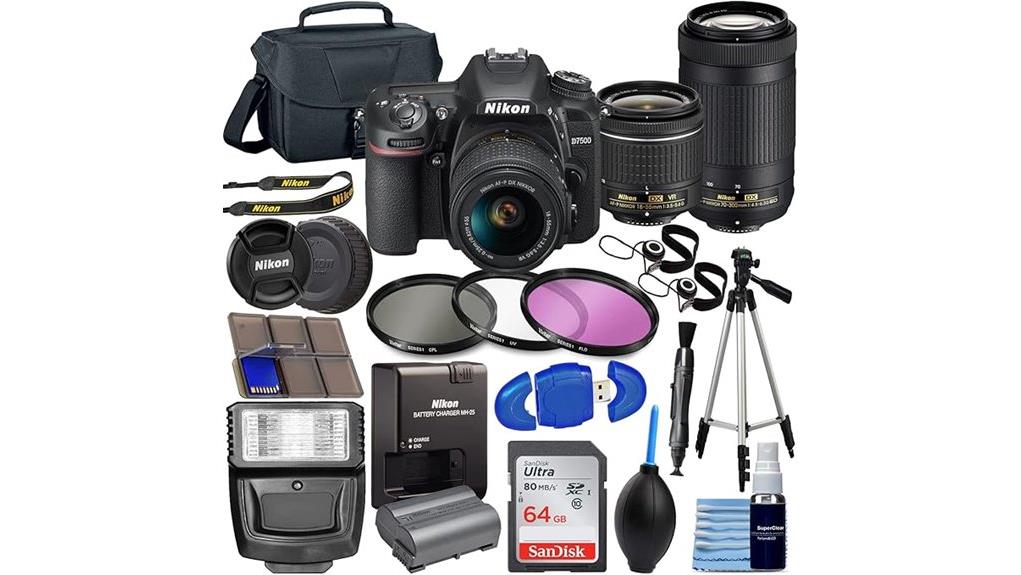
You’ll find the Nikon D7500 gives pro-level DX performance in a compact body: a 20.9MP sensor with EXPEED 5 yields detailed files and controlled noise to ISO 6400, while the Multi-CAM 3500FX II AF and 8 fps bursts handle action with predictive tracking. It shoots 4K/30p, offers Wi‑Fi/Bluetooth and USB 3.0 tethering, and uses lens VR for stabilization. Battery and buffer limit long sessions, and the rest of the review explains practical tradeoffs and workflow tips.
Some Key Takeaways
- 20.9MP DX sensor with EXPEED 5 delivers detailed images and good tonal gradation, with usable noise control up to ISO 1600–6400.
- Multi-CAM 3500FX II AF system (51 points) and 180k‑pixel RGB metering provide reliable subject tracking and 8 fps continuous shooting.
- 4K UHD (30p) recording with HDMI output; internal H.264 limits bitrate, so external recording recommended for higher-quality video.
- Ergonomic controls, customizable menu, and modest weather sealing balance pro features with portability for serious enthusiasts.
- No in-body stabilization; image stabilization depends on VR lenses, and battery life varies greatly with 4K, live view, and high-speed bursts.
Nikon D7500 at a Glance: Who This DSLR Is For
While the D7500 packs advanced features borrowed from Nikon’s higher-end bodies, it’s aimed at serious enthusiasts and hybrid shooters who want pro-level performance without a full-frame price. You’ll find ergonomic controls that balance grip and access, improving handling during long shoots and rapid adjustments. Menu navigation remains streamlined compared with pro models, yet offers extensive customization. Build quality is robust for its class, using durable materials that reduce flex. Though not fully weatherproof, modest weather sealing helps in light rain and dusty environments, making the D7500 a practical, cost-effective bridge between consumer and pro DSLRs. It’s also a good match for those invested in mirrorless camera accessories who want to expand their kit with compatible lenses and support gear.
Real‑World Image Quality and Low‑Light Performance
Because it borrows the EXPEED 5 pipeline and a 20.9 MP DX sensor from Nikon’s higher‑end models, the D7500 delivers detailed images with good tonal gradation and controlled noise up to mid‑range ISOs, making it suitable for prints and cropping without severe penalty. You’ll find high ISO resilience useful when shooting available light: images at ISO 1600–6400 retain luminance detail, though color saturation and microcontrast degrade versus base ISO. In comparative color fidelity testing the camera reproduces hues accurately with standard profiles, but expect modest hue shifts in extreme low light; careful white balance and noise reduction preserve usable results. For photographers aiming for consistent on‑screen and print results, proper monitor calibration ensures the D7500’s color and tonal detail are represented accurately.
Autofocus, Burst Speed, and Shooting Responsiveness
Though it shares Nikon’s robust Multi‑CAM 3500FX II system, the D7500 puts a 51‑point AF array and a 180k‑pixel RGB metering sensor to work in a mid‑tier body, so you’ll get accurate phase‑detect focusing across a wide area and reliable subject tracking with Group Area AF. You’ll notice responsive lock times in single and continuous modes, comparable to higher-tier DX bodies. Continuous shooting at 8 fps pairs well with predictive AF, though sustained bursts depend on buffer management and card speed. Overall, autofocus accuracy and shooting responsiveness balance performance and cost without unusual compromises. The camera is well suited for enthusiasts who enjoy photography and want a balance of features and value, especially those shopping for digital cameras.
4K Video, Connectivity, and Workflow Features
If you need 4K capture and straightforward file transfer, the D7500 delivers a capable, workmanlike package: it records UHD 3840×2160 video at 30 fps with HDMI output for external recorders, and pairs onboard Wi‑Fi and Bluetooth SnapBridge connectivity with a USB 3.0 port for faster tethering and file offload. You’ll appreciate practical workflow tools: reliable wireless tethering for quick selects, USB 3.0 for bulk offload, and HDMI pass-through for external codecs and recorders. Codec options are limited compared with cinema-oriented bodies, so expect intra-camera H.264-based files and plan external recording if you need higher bitrates or 10-bit capture. For photographers using external monitors or recorders, choosing a high-quality micro HDMI cable can ensure reliable video output and minimal signal issues.
Kit Lenses, Stabilization, and Outdoor Shooting Reach
Start by looking at the two bundled AF‑P DX NIKKOR zooms: the 18–55mm f/3.5‑5.6G VR gives you a compact, general‑purpose wide‑to‑short‑tele range with built‑in VR, while the 70–300mm f/4.5‑6.3G ED extends reach for distant subjects but sacrifices low‑light aperture and autofocus speed. You’ll evaluate lens reach versus aperture tradeoffs: 18–55 covers everyday scenes; 70–300 supplies long focal lengths up to 300mm. Stabilization effectiveness is lens‑dependent; the 18–55’s VR yields usable handheld shutter speeds, while the 70–300 benefits from VR but still needs higher ISO or tripod in low light. Consider pairing these lenses with a camera slider to add smooth motion and enhance outdoor shooting compositions with controlled movement camera sliders.
Battery Life, Storage Limits, and Portability Considerations
When planning long shoots, you’ll balance the D7500’s respectable EN‑EL15a battery life against its storage and weight tradeoffs: a single EN‑EL15a typically delivers dozens of hundreds of shots (real‑world figures vary by use of continuous 8 fps bursts, live view/4K recording, and flash), while the bundled 64GB Class‑10 SDHC card limits raw capacity to roughly 211 minutes of video or about a few hundred RAW frames before you need to swap or offload. Plan for spare batteries and additional SD cards to extend Battery lifespan; compare card speeds for sustained 4K. The kit’s dual-lens bundle increases weight, reducing Carry convenience. Consider keeping at least one spare EN‑EL15a and an extra high‑speed SD card to keep shooting.
Value Verdict: Strengths, Weaknesses, and Who Should Buy
Although the D7500 sits below Nikon’s flagship APS-C bodies, it delivers a compelling mix of speed, image quality, and features that make it a strong value for advanced enthusiasts and hybrid shooters. You get 8 fps, reliable 51‑point AF, 4K video, and solid low‑light performance from EXPEED 5 and the 20.9MP sensor. Strengths include ergonomics, accessory ecosystem and competitive resale value versus mirrorless peers. Weaknesses are no in‑body stabilization and limited weather sealing. If you prioritize optical viewfinder handling, battery life, and vendor user support, the D7500 is a pragmatic, cost‑efficient choice. For photographers building out their kit, the camera fits well within the broader range of essential gear for DSLR enthusiasts.
Some Questions Answered
Is This an Import Model With Full Manufacturer Warranty Coverage?
Yes — you’re getting an import status unit; it’s listed as an import model. Warranty coverage differs: vendor offers a voluntary 30-day return guarantee, but full manufacturer warranty may not apply for imported units. Comparatively, domestic models typically include full manufacturer warranty; imported units often rely on seller support or third‑party warranties. You’ll want to verify warranty coverage with the seller before purchase to confirm repair and service terms meet your requirements.
Can the Included Flash Act as a Master for Off‑Camera TTL?
No — the included slave flash can’t act as a master for off‑camera TTL. You’ll need an external master‑capable unit or a wireless commander for full flash control and TTL compatibility. Comparatively, the built‑in flash can trigger slave units optically but only in basic slave mode; it doesn’t provide TTL pass‑through or advanced flash control. For full off‑camera TTL and multi‑channel control, choose a dedicated Nikon master flash or radio commander.
What Exact SD Card Speeds and UHS Class Are Supported?
The camera supports SDUHS speed up to UHS‑I with Class performance equivalent to SDHC Class 10 (V60 noted for packaged card). You’ll get write speeds around 30 MB/s on the included 64GB card; the body accepts SD/SDHC cards to 64GB. Comparatively, it won’t exploit UHS‑II bus speeds, so higher UHS‑II cards won’t yield faster sustained writes despite backward compatibility; choose fast UHS‑I/Class 10/V ratings.
Are Firmware Updates and Manuals Included or Downloadable?
Yes — firmware availability is provided but physical updates aren’t included; you’ll download firmware and manual downloads from Nikon’s support site. Technically, the vendor supplies links and guidance; Nikon posts firmware files, release notes, and PDF user manuals. Comparatively, this matches typical DSLR practice: you’ll update via memory card/USB and keep manuals locally. Check model D7500 support pages for the latest firmware version and installation instructions before updating.
Does the Tripod Included Support Quick‑Release Plates?
No — the included 50″ tripod typically uses a fixed mounting plate and doesn’t support a detachable quick‑release plate. You’ll face compatibility concerns if you expect Arca‑Swiss or camera‑specific quick‑release systems. For setup tips, remove the tripod head’s screw to check thread size and consider swapping the head for a third‑party quick‑release model or adding a universal quick‑release adapter; this gives faster camera changes and broader compatibility.