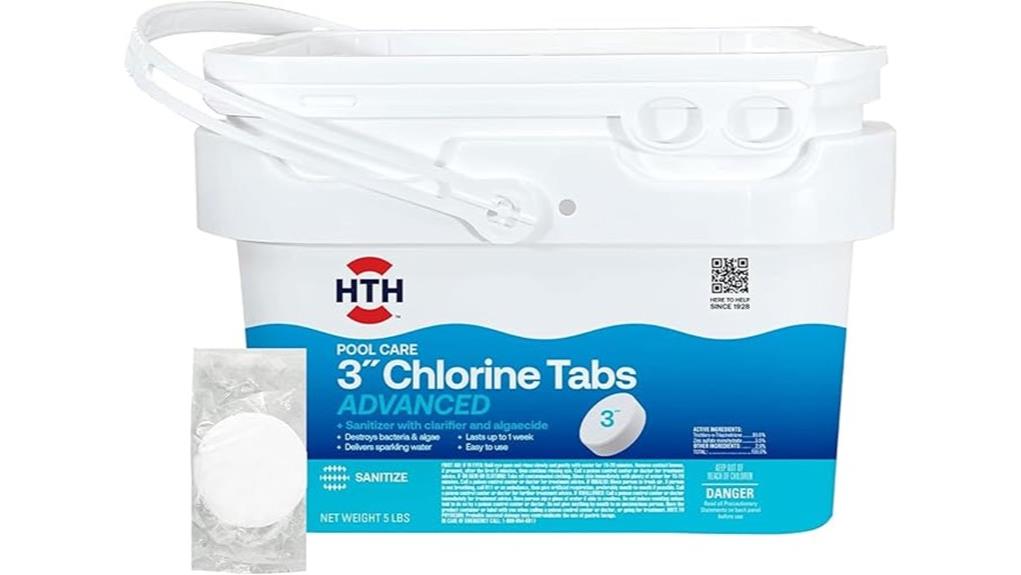
You’ll find HTH 42052W 3″ stabilized chlorine tablets offer reliable, low‑maintenance sanitization for residential pools, dissolving slowly in feeders or skimmers to maintain free chlorine around 1–4 ppm. The 5 lb sealed canister contains foil‑wrapped, sun‑protected tablets that slow degradation but raise cyanuric acid over time. Use a calibrated feeder, keep tablets dry and away from return jets, and monitor levels weekly to control dissolution and longevity; continue for detailed usage and alternatives. Using HTH 42055 pool care tab benefits can enhance your pool maintenance routine significantly. These tablets not only help in maintaining sanitized water but also contribute to overall water clarity. Regular use of these products ensures that your pool remains inviting and safe for swimming throughout the season.
Some Key Takeaways
- Stabilized 3″ HTH tablets (model 42052W) provide slow-dissolving, multi-function chlorination for consistent 1–4 ppm free chlorine.
- Foil-wrapped 5 lb canister with child-resistant lid and moisture barrier ensures long shelf life and safe storage.
- Best used in feeders, skimmers, or floaters; avoid direct return jets to prevent rapid erosion and over-chlorination.
- Increases cyanuric acid over time, so occasional pool dilution or partial water replacement is needed.
- Reliable, low-maintenance option for residential pools; alternatives include dichlor granules, liquid bleach, or salt generators.
Quick Verdict: Is HTH 42052W Worth Buying?
If you want a reliable, low-maintenance sanitizer for most residential pools, the HTH 42052W delivers: its slow-dissolving, individually wrapped 3″ tablets combine sanitizing, clarifying, and algaecide functions, are sun-protected for extended chlorine life, and are compatible with vinyl-lined and saltwater systems. You’ll find performance dependable: sustained chlorine release maintains 1–4 ppm with weekly tablet replacement in feeders or skimmers. In a cost comparison versus bulk granules or unstabilized chlorine, tabs lower labor and dosing error. Consider environmental impact: stabilized chlorine reduces photodegradation but increases cyanuric acid load, requiring periodic dilution or partial water replacement.
What’s in the Box and Key Specs (Size, Weight, UPC, Model)
When you open the package you’ll find a single 5‑pound container holding individually wrapped 3‑inch HTH chlorine tablets (Model 42052W, Manufacturer Part Number 42052W; UPC 073187900005; ASIN B0BV7HQ1CC). The box contents are limited to one sealed canister; each tablet is foil-wrapped to preserve potency and reduce dust. Key specs: item weight 5 lbs, tablet diameter 3 inches, item form: tablet, brand HTH, manufacturer Innovative Water Care. Packaging details emphasize moisture barrier and child-resistant lid. Follow storage tips: keep container upright, cool, dry, away from organics and direct sunlight; reseal after use to maintain stability.
Real-World Performance: Sanitizing, Clarifying, and Algae Control
Having unpacked the canister and confirmed proper storage, you can assess how these 3″ HTH tablets perform in real-world sanitizing, clarifying, and algae-control tasks. You’ll observe consistent free chlorine levels within the recommended 1–4 ppm when dissolved slowly in feeders or skimmers, indicating reliable chlorine persistence. Water clarity improves as the formula combines oxidative sanitization with particulate clarification; turbidity reductions are measurable within 24–48 hours under normal loads. Algae colonies are suppressed effectively; however, heavy nutrient loads may require supplemental treatment if algae recurrence appears. Document residuals and adjust feed location to maintain target concentrations.
How to Use HTH 42052W Safely and Get It to Last Up to a Week
Because proper placement and dosing control dissolution, you’ll get consistent chlorine release and extend each 3″ HTH tablet’s life up to a week by using a calibrated feeder or skimmer and maintaining recommended pool chemistry. You should wear gloves and eye protection when handling; follow manufacturer directions and keep tablets dry in original packaging for safe storage. Use calibrated automatic feeders for uniform feed rate; if using skimmer baskets or floaters, position tablets away from direct return jets to avoid rapid erosion. Monitor free chlorine 1–4 ppm and adjust feeder settings. Store away from combustibles and children, and avoid mixing with other chemicals.
Who Should Buy This and Alternative Options to Consider
If you maintain a residential pool and need a low-maintenance, slow-release sanitizer that also clarifies and controls algae, the HTH 42052W is a suitable choice; it’s designed for use in feeders, floaters, or skimmer baskets and delivers predictable chlorine levels when you monitor free chlorine at 1–4 ppm. You should buy this if you want single-product sanitization with weekly dosing and compatibility with vinyl and salt systems. Budget shoppers will value 5 lb packaging and multi-function chemistry. Alternatives: stabilized dichlor granules for variable dosing, liquid bleach for rapid shock, or a salt-chlorine generator if you prefer automated generation. Hth pool care product features make it easy to achieve crystal-clear water while minimizing the amount of time spent on maintenance. Users appreciate the effectiveness of the formula, especially in regions with varying weather conditions. By choosing HTH, you can enjoy a reliable solution that fits within your pool care regimen.
Some Questions Answered
Are These Tablets Safe to Store With Other Pool Chemicals?
No — you shouldn’t store these chlorine tablets with other pool chemicals. You must practice chemical segregation to prevent hazardous reactions; keep oxidizers like chlorine isolated from acids, algaecides, and combustible materials. Store tablets in their original, sealed packaging, in a cool, dry area with proper storage ventilation to dissipate fumes and heat. Label secondary containers, maintain separation distances, and follow manufacturer and local regulations for safe chemical storage.
Do Individually Wrapped Tablets Dissolve Differently Than Unwrapped Ones?
Yes — packaging impact can alter dissolution rate. You’ll find individually wrapped tablets delay initial moisture exposure, so they start dissolving slightly later than unwrapped ones once placed in water. The wrapper prevents pre-dissolution degradation and maintains active chlorine longer during storage. Once unwrapped or submerged in water, dissolution rate is governed by tablet composition and hydrodynamics, not the prior wrapping, yielding comparable in-use release profiles.
Can I Use These Tabs in an Automatic Chlorinator?
Yes — you can use these tablets in an automatic chlorinator. They offer feeder compatibility with most tablet feeders and tablet feeders designed for 3″ chlorine tabs. You should verify your chlorinator’s manual for material compatibility and adjust the feed rate based on pool volume, current free chlorine (1–4 ppm target), and tablet dissolution speed. Monitor chlorine levels twice weekly and fine-tune the feed rate to maintain stable sanitizer concentration. Choosing the best chlorine tabs for pool maintenance can greatly enhance the effectiveness of your chlorinator. Some brands even include additional features, such as slow dissolution technology, which can help sustain chlorine levels longer between treatments. Always read the labels carefully to ensure you’re selecting a product that meets your pool’s specific requirements.
Are These Chlorine Tablets Safe for Pets Around the Pool Area?
They’re not inherently safe for pets; you should minimize pet exposure and prevent animal ingestion. Keep tablets stored securely and avoid pets licking or drinking treated pool water if chlorine exceeds recommended 1–4 ppm. Individual-wrapped, slow-dissolving tablets reduce dust, but direct contact can irritate skin, eyes, or paws. Monitor water chemistry, fence off the pool when dosing, and contact a veterinarian immediately if you suspect animal ingestion or chemical exposure.
Do They Affect Pool Water pH Significantly Over Time?
Yes — they’ll raise chlorine demand and can slowly lower pH over time if not managed. You’ll see small acidifying effect from trichlor-type tablets, increasing chlorine demand as stabilizer levels (cyanuric acid) rise, which reduces free chlorine efficacy. Test pH, total alkalinity, free chlorine, and stabilizer levels twice weekly. If pH drifts down, add alkalinity increaser or soda ash and reduce tablet feed or use less stabilizer-containing products.