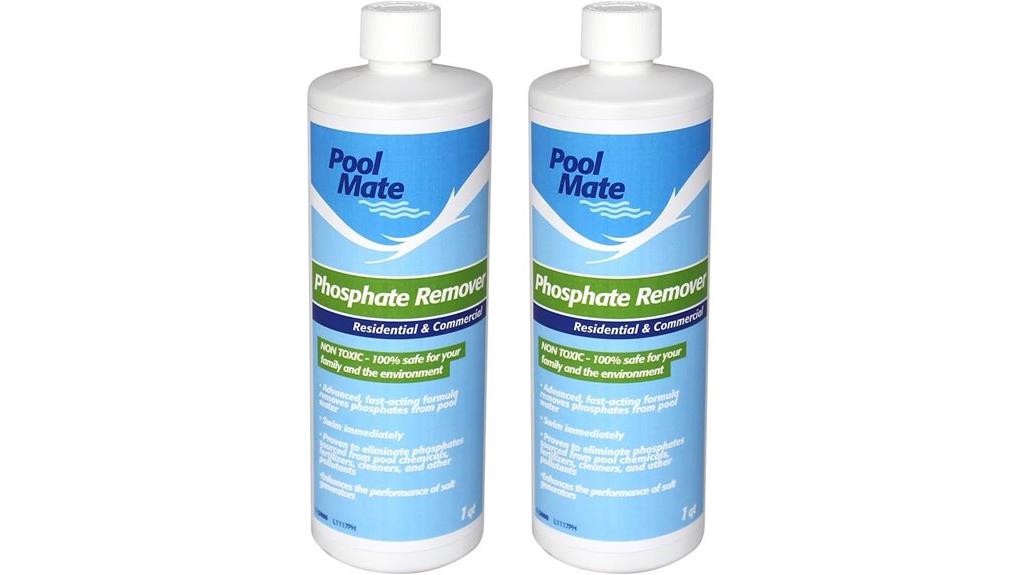
You’ll find Pool Mate Premium Phosphate Remover is a concentrated, filter-assisted formulation that strips dissolved phosphates to curb algae and lower sanitizer demand. You’ll dose by pool volume (maintenance: 1 oz/5,000 gal), run filtration during treatment, then retest to confirm drops toward ≤100 ppb. It binds and flocculates orthophosphate into filter-trappable particles, works with common sanitizers, and allows immediate swimming. Continue for detailed dosing, safety, and cost comparisons.
Some Key Takeaways
- Effectively reduces dissolved phosphates by binding and precipitating them, lowering bioavailable phosphorus and algae nutrient supply.
- Typical maintenance dose is 1 oz per 5,000 gallons, with measurable declines toward ≤100 ppb in one treatment cycle.
- Works via chelating and flocculating agents; filtration must run to capture precipitated particles for full removal.
- Compatible with all sanitizers and allows immediate swimming, though users should retest phosphate levels after treatment.
- Requires PPE, 24–36 hours filtration, and filter cleaning/backwash when pressure rises to remove flocculated material.
What Pool Mate Premium Phosphate Remover Is and Who It’s For
Think of Pool Mate Premium Phosphate Remover as a targeted chemical treatment that strips dissolved phosphates—the primary nutrient for algae—from pool water; you use it when you need to lower phosphate concentrations to reduce algae growth and sanitizer demand. You’ll find a 1-quart, 2-pack formulation designed for routine maintenance and corrective use. Target users are pool operators, residential owners, and maintenance professionals who monitor phosphate ppb and water chemistry. You’ll apply it with filtration running, follow dosing per gallons, and retest. It’s compatible with all sanitizers, allows immediate swimming, and integrates into a protocol that emphasizes testing, filtration, and follow-up cleaning.
How the Formula Works and Key Benefits for Your Pool
Because dissolved phosphates feed algae, Pool Mate’s formula binds and precipitates those phosphorous compounds into filter-trappable particles, rapidly reducing available nutrients and lowering phosphate ppb. You’ll observe targeted nutrient sequestration: chelating and flocculating agents convert soluble orthophosphate into insoluble complexes the filter captures. This lowers bioavailable phosphorus, reducing algal metabolic substrate and enabling measurable algae suppression. The action minimizes sanitizer demand by cutting nutrient-driven chlorine consumption. Mechanistically, the formula is compatible with standard sanitizers and won’t interfere with residual disinfectant efficacy. Overall, you’ll get predictable phosphate decline, improved filter removal efficiency, and a more stable, algae-resistant pool environment.
Real-World Performance: Dosage, Application, and Results
When you follow the labeled dosing and application steps, Pool Mate Premium delivers consistent phosphate reductions across typical residential pools: for maintenance dosing (1 oz per 5,000 gallons) you can expect measurable declines toward the target ≤100 ppb within a single treatment cycle, while treatment-level doses called for after algae control produce larger, faster drops as the formula flocculates and settles bound phosphates for filter removal. You’ll appreciate dosage accuracy—small deviations change kinetics noticeably. Strict application timing with filter running ensures even dispersion. Results tracking via test kit validates reduction and informs retreatment intervals. Monitor filter interaction to remove flocculated material efficiently.
Compatibility, Safety, and Maintenance Checklist
Having confirmed that dosing and filtration remove phosphates effectively, you should now verify compatibility, observe safety protocols, and follow a concise maintenance checklist to preserve system performance. You’ll make certain product compatibility with your sanitizer and test phosphate levels before and after treatment using a calibrated phosphate test kit. Wear gloves and eye protection; avoid inhalation and skin contact. Run filtration 24–36 hours, monitor filter pressure, and perform filter maintenance—backwash or clean cartridges when pressure rises per manufacturer specs. Shock, brush, and vacuum to capture precipitated particulates. Retest pool chemistry and document results; repeat maintenance only if phosphate rebound occurs.
Buying Considerations: Cost, Packaging, and Recommended Alternatives
If you compare unit price and packaging, Pool Mate Premium Phosphate Remover‘s 1‑quart 2‑pack (64 fl oz total) delivers a competitive cost-per-gallon treatment rate for routine maintenance—calculate cost per ounce against your weekly dosing needs (1 oz per 5,000 gallons) to determine long‑term value. You should perform a price comparison with single‑quart and bulk phosphate products; factor shipping, warranty, and return policy. Assess packaging durability: the twin plastic bottles resist puncture and seal integrity issues during storage and handling. Recommended alternatives include concentrated bulk phosphate removers and multi‑function clarifiers when filter loading or budget constraints dictate different treatment strategies.
Some Questions Answered
Can It Be Used in Vinyl or Saltwater Pools During Winterizing?
Yes — you can use it in vinyl and saltwater pools during winterizing. You’ll maintain vinyl care by avoiding abrasive treatments and following dosage; product is compatible with all sanitizers, so saltwater compatibility is confirmed. Dose based on gallonage and phosphate test results, run filtration per instructions, then shock and vacuum before shutdown. Monitor filter pressure and clean; retest phosphates to guarantee levels stay below 100 ppb for effective winter protection.
Does It Affect Pool pH or Alkalinity Readings?
No — you won’t see significant pH impact or alkalinity interference when using this product as directed. The formula targets dissolved phosphates and binds them for filtration rather than chemically neutralizing acids or bases, so pH and total alkalinity typically remain stable. You should still test pH and alkalinity after treatment; heavy dosing or concurrent chemical additions could necessitate minor adjustments to restore ideal balance.
How Long Is the Unopened Product Shelf Life?
The unopened product shelf life isn’t specified on packaging, so you should assume a conservative two-year unopened shelf life from the manufacture date unless manufacturer confirms otherwise. Store at recommended storage temperature (cool, dry, away from direct sunlight) to preserve efficacy. For precise validation, contact Pool Mate with the manufacture date and lot number; they can provide stability data or an extended shelf-life recommendation based on batch-specific testing and warranty terms.
Is This Safe for Pools With Live Plants or Fish?
Yes — it’s generally safe for pools with live plants or fish when used per label directions. You’ll make certain safe for wildlife and plant compatibility by dosing based on phosphate test results, avoiding overapplication, and maintaining filtration during the 24–36 hour treatment window. Run pumps, monitor water chemistry, and avoid direct concentrate contact with fauna. If you’re uncertain, perform a small-scale trial and consult manufacturer support for aquatic-systems guidance.
Can It Be Mixed With Other Pool Chemicals in the Same Day?
Yes — you can’t mix chemicals directly; avoid combining products in the same container. For safe chemical interaction and best application timing, add the phosphate remover separately with filter running, wait 24–36 hours of filtration before shocking or adding other major chemicals, and retest phosphate levels. If algae are present, use Algae Erase first per instructions, then follow the phosphate dosing chart. Monitor filter pressure and clean as needed.