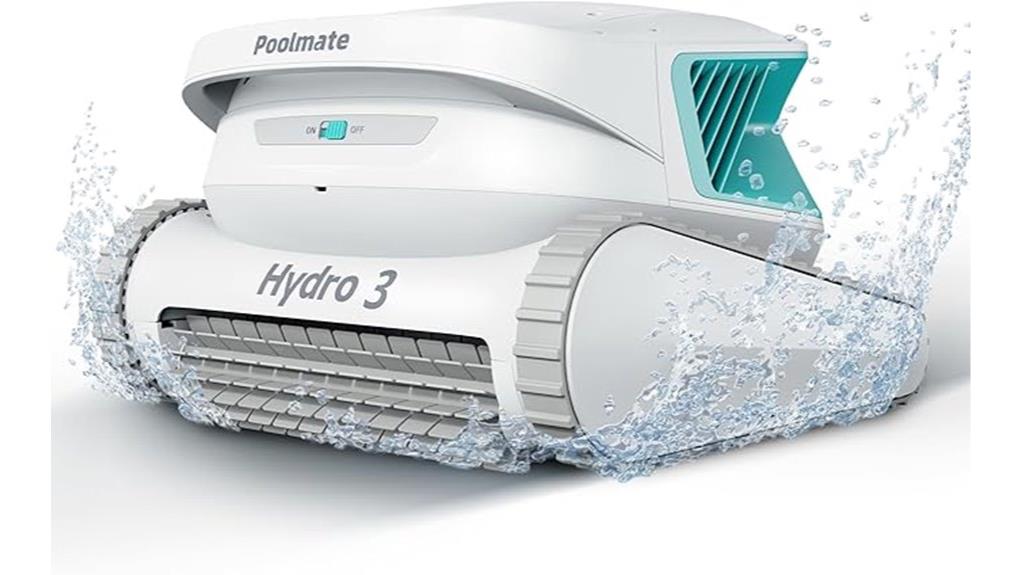
The Hydro 3 is a cordless, 15‑lb robotic pool vacuum that’s ideal if you want simple, portable cleaning for small inground or above‑ground pools. You’ll get up to 200 minutes per charge, strong dual‑pump suction, brushes that tackle floors, walls and waterline, and a 4.1 L top‑access filter for fur, sand and leaves. It’s lightweight with IP68 protection and easy upkeep, though batteries and parts add cost—keep going to learn full performance, maintenance, and buying tradeoffs. The 3in1 cordless pool cleaner features advanced technology that makes cleaning even more effective. With its multiple functions, it not only vacuums debris but also scrubs surfaces for a thorough clean. You can easily switch between settings, ensuring optimal performance for any pool type.
Some Key Takeaways
- Cordless 15-pound Hydro 3 offers up to 200 minutes runtime and IP68 protection for easy, portable pool cleaning.
- Dual-pump suction plus scrubber brush effectively removes sand, hair, leaves, and climbs walls and waterline.
- 4.1 L top-access ultrafine filter (180 µm nylon) captures debris and is simple to empty and rinse.
- Hydrocurve navigation and obstacle-handling tracks improve coverage for pools up to about 1,076 sq. ft.
- Pros: lightweight, energy-efficient, one-press use; cons: limited warranty and extra cost for replacement batteries.
What the Hydro 3 Is and Who It’s Best For
Meet the Hydro 3: a cordless, ultra-light robotic pool vacuum built for homeowners who want effortless, portable cleaning for inground or above-ground pools. You’ll find a wireless, 15-pound unit with one-press activation, IP68 protection, and up to 200 minutes runtime. It’s best for small pool owners who need straightforward maintenance without hoses or complex setup. If you’re a homeowner with pets, the 4.1 L ultrafine filter captures fur, sand, and debris efficiently. You’ll appreciate easy top-access filtration, self-parking on low battery, and simple storage—practical, portable, and tailored to busy residential use. The Y50s robotic pool vacuum features advanced mapping technology that allows it to efficiently navigate your pool’s layout. With its powerful suction and smart sensors, it ensures thorough cleaning while avoiding obstacles and edges. Additionally, its sleek design and compact size make it easy to store when not in use, providing an ideal solution for maintaining a pristine swimming environment.
Real-World Cleaning Performance: Suction, Brushes, and Coverage
When you run the Hydro 3, its dual-pump suction and scrubber brush combination quickly tackle common pool grime—sand, hair, and leaves—while the Hydrocurve navigation helps the robot cover irregular surfaces without getting stuck. You’ll notice strong suction consistency across sessions, pulling debris into the 4.1 L top-access filter without frequent clogs. Brushes scrub floors, walls, and the waterline effectively; expect gradual brush wear after heavy seasonal use but straightforward replacement. Coverage reaches typical residential pools up to about 1,076 sq. ft., and obstacle-handling tracks reduce hang-ups, so cleaning is thorough and predictable. Hydro 4 features for pool cleaning enhance the overall efficiency of your maintenance routine. With its advanced filtration system, it captures even the smallest particles, ensuring crystal-clear water. Additionally, the robotic design allows for effortless maneuvering, making it an invaluable tool for pool owners.
Battery, Runtime, Charging, and Remote Usability
Although the Hydro 3 uses a compact, high-efficiency 25.2 V lithium‑ion pack, you’ll get an impressive runtime — up to 200 minutes per charge — which is enough for most residential pools. You’ll appreciate the four‑hour recharge and water‑resistant charging cradle that resists corrosion and reduces downtime. Battery safety features are sensible: thermal protection and sealed housings limit risk during use and charging. The included remote is simple; Remote ergonomics favor one‑hand control, clear buttons, and a readable layout, though range isn’t exceptional. Overall, charging is fast, runtime generous, and controls are practical for everyday pool maintenance.
Filtration, Maintenance, and Durability (What to Clean and How Often)
Regularly checking and cleaning the Hydro 3’s 4.1 L top-access filter basket keeps suction strong and prevents clogs, so you should empty it after heavy debris loads and at least once a week during peak use. You’ll rinse the 180 µm nylon screen, clear trapped hair and fine sand, and inspect seals for wear. Schedule deeper cleanings monthly—remove and hose internal components, check brushes and tracks for abrasion, and test motors. Keep a spare basket for quick filter replacement. Before seasonal storage, fully dry the unit, charge the battery partially, and store indoors to prolong durability.
Should You Buy It? Pros, Cons, Cost Considerations, and Alternatives
If you want a lightweight, cordless robot that handles floors, walls, and the waterline with long runtime and easy maintenance, the Hydro 3 is a strong contender. You’ll get long 200-minute runs, easy top-access filters, and IP68 protection for simple seasonal storage. Pros: excellent energy efficiency, strong suction, wall-climb, and accessory compatibility with common fittings. Cons: limited warranty, 15-pound unit may still strain some users, and replacement batteries cost extra. Consider cost vs. manual cleaners or tethered robots if budget matters. Factor resale value, parts availability, and your pool size before buying. Poolmate hydro 4 performance review indicates that users appreciate its advanced filtration system and versatile cleaning capabilities. Many highlight its efficiency in handling debris and algae, making it ideal for various pool environments. Additionally, customer feedback often emphasizes the ease of setup and operation, providing a seamless user experience right from the start.
Some Questions Answered
Can It Be Used in Saltwater Pools Long-Term?
Yes — you can use it long-term in saltwater pools, but you should be cautious. The Hydro 3’s IP68 protection and corrosion-proof charging help resist salt corrosion, yet prolonged exposure raises risk to seals, tracks, and electronics. You’ll want diligent rinsing, inspection, and record keeping. Check warranty coverage details: salt damage may not be fully covered, so confirm terms or consider extended protection to avoid surprise repair costs.
Is There a Mobile App for Scheduling or Controls?
Yes — you can schedule and control runs via a mobile scheduling feature. The Hydro 3 uses Bluetooth pairing to connect your phone for basic start/stop, mode selection, and scheduling within range. It’s convenient and straightforward, but don’t expect advanced remote or cloud features; Bluetooth limits range and concurrent control. For full-time remote access you’ll need a Wi‑Fi bridge or third‑party solution; otherwise the onboard app covers routine scheduling reliably.
How Loud Is the Robot During Operation (Decibel Level)?
You’ll hear the robot at a moderate level — around 55–62 dB at poolside during operation. The motor noise is noticeable but not intrusive, comparable to a quiet dishwasher; water vibration adds low-frequency hums that mask some high pitches. You’ll find it acceptable for daytime use; at night it may be more apparent. Overall performance balances suction and noise, so you’re getting strong cleaning with reasonable acoustic impact.
Are Replacement Filters and Parts Widely Available?
Yes — you’ll find replacement cartridges and parts reasonably available. Poolmate supplies OEM filters, and aftermarket availability is growing through online retailers and specialty pool shops. You’ll want to verify compatibility (Hydro3-2026 model) before buying, since some third-party cartridges vary in fit and filter grade. Overall access is good, but stick to reputable sellers to guarantee proper filtration performance and to preserve warranty coverage.
Can Multiple Units Run Simultaneously Without Interference?
Yes — you can run multiple units simultaneously without notable signal interference. You’ll get effective simultaneous operation because the Hydro 3 uses autonomous onboard control rather than constant remote signaling, so remote conflicts are unlikely. Just avoid placing multiple chargers or strong RF sources nearby. Test two units together first; observe overlap and retrieval behavior, and separate start times slightly if you spot minor path clustering or occasional control handshake issues.