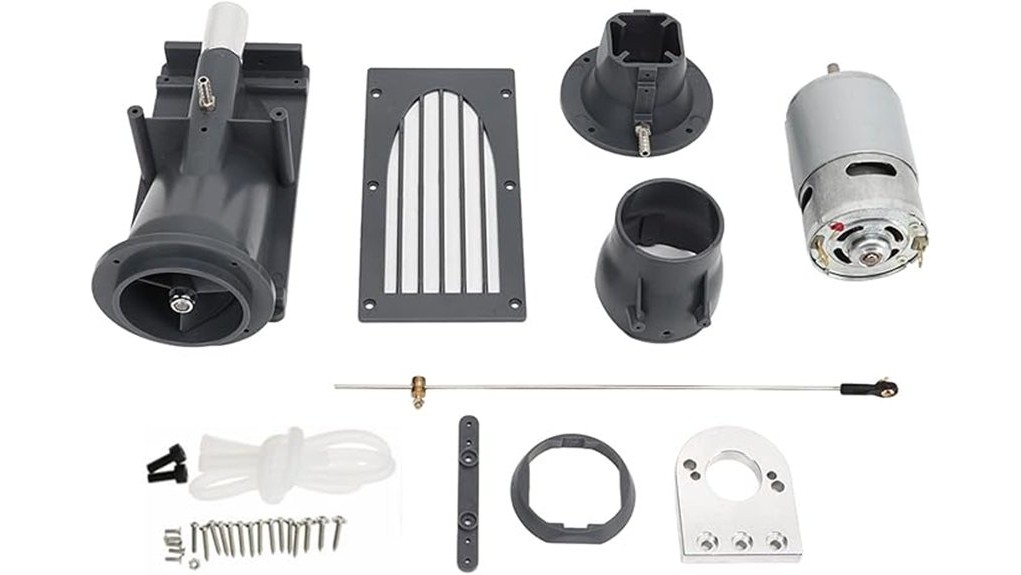
You’ll get compact, high‑RPM thrust from the 40mm jet pump with a 775 brushed motor, ideal for 80–120 cm hulls but with narrow efficient throttle windows and cavitation risk from the small intake. The molded polymer housing and alloy reinforcements keep weight down, though UV and salt corrosion need care. Expect heat buildup—plan cooling and brush maintenance—or consider a brushless swap. Keep going for detailed fitment, thermal and durability guidance.
Some Key Takeaways
- 40mm jet pump with a 775 brushed motor suits 80–120 cm hulls, offering concentrated thrust for small displacement craft.
- Peak thrust occurs at mid-to-high RPM (~10,000–16,000 RPM at 12V), with narrow throttle windows for optimal thrust-per-watt.
- Polymer housing and alloy reinforcements balance weight and strength; UV aging and corrosion protection are concerns.
- Thermal management (heat sink, airflow, or fan) and routine brush/seal maintenance are required for reliability.
- Consider cavitation risk from the small intake, saltwater corrosion, and brushless alternatives for efficiency and longevity.
Performance and Power: What the 40mm Jet Pump With 775 Brushed Motor Actually Delivers
Because the 40mm jet pump pairs a compact impeller housing with a 775 brushed motor, you can expect high shaft speeds (10,000–16,000 RPM at 12V) and concentrated thrust suited for 80–120 cm hulls. You’ll see a steep thrust curve: peak thrust at mid-to-high RPM with rapid falloff below effective cutoff. Efficiency mapping shows usable bands where thrust per watt maximizes—plan for narrow ideal throttle windows. Cavitation testing is essential; small diameter intakes amplify vapor risk under heavy load. Throttle response is crisp due to the brushed motor, but monitoring thermal rise and matching propulsive load keeps performance predictable and repeatable. This makes the pump a compact option for kayak and fishing enthusiasts seeking efficient, portable propulsion.
Build, Materials, and Durability: How the Plastic, Alloy and Metal Parts Hold Up
While the 40mm jet pump uses a lot of plastic in its external housing, you’ll find alloy reinforcements and metal internals where strength and heat transfer matter most. You’ll notice injection-molded polymer for the casing and impeller shroud; alloys at load points reduce flex and concentrate stress away from plastic joints. Iron and copper motor internals handle torque and thermal conduction; the included heat sink aids thermal stability. Evaluate for material aging: polymers may craze under UV and cyclic load, alloys show fatigue only after extensive use, and corrosion resistance depends on plating and maintenance in saltwater environments. For paddlers and DIY repairers, consider compatibility with plastic welding kits when planning long-term maintenance and repairs.
Installation, Fitment, and Compatibility With 80–120 Cm Hulls and DIY Builds
If you’re fitting the 40mm PODSJD jet pump into an 80–120 cm hull, plan placement around the assembly’s 210 mm length and 7.87 x 4.72 x 2.75-inch footprint so the intake, mounting points, and steering clearances align with your hull geometry. You’ll secure the unit with low-profile mounting brackets to minimize trim changes; verify bolt pattern and anti-slip nuts clear internal ribs. Route the wiring harness along a protected channel to avoid chafing and maintain center of gravity. Confirm stern tunnel depth and transom cutouts match pump intake to prevent cavitation. Fitment is straightforward but demands measurement and reinforcement. For easier launches and overland moves, consider integrating a kayak cart into your setup to protect the hull and simplify transport.
Thermal Management, Noise, and Maintenance: Keeping the 775 Motor Healthy
Having positioned and secured the 210 mm pump assembly in your 80–120 cm hull, you now need to manage the 775 brushed motor’s heat, noise, and wear to preserve performance. Monitor temps under load; the stamped heat sink helps but add cooling mods—ducted airflow or small axial fans—to keep RPMs within spec. Evaluate motor mounting stiffness to reduce vibration transfer; resilient mounts cut audible noise and wear. Inspect seals routinely for water ingress and use dielectric grease on terminals. Consider brushless conversion if you need higher efficiency and lower maintenance, but weigh cost against compatibility and mounting redesign. For rugged water adventures, also secure external wiring and components with Gorilla Tape to resist moisture and abrasion.
Who Should Buy This Thruster and Alternatives to Consider Before You Order
Because this 40mm jet pump pairs a 775 brushed motor with a compact 210mm assembly, you should buy it when you need a low-cost, easy-to-install thruster for 80–120cm hulls, DIY mini-ROVs, or kayak/trolling applications and can accept regular brush maintenance and moderate heat management. You’ll benefit if you prioritize compact form, reversible thrust, and straightforward mounting. Consider battery options that supply stable 12V and adequate current; plan for waterproof coatings on exposed electronics and shaft seals. Alternatives: brushless micro-impellers for higher efficiency and longevity, or larger-diameter pumps for heavier displacement boats. For extended trips on the water, pair your power system with a reliable emergency power bank to keep electronics and pumps running when away from shore.
Some Questions Answered
Is a Separate Motor Controller or ESC Required for 12V Operation?
Yes — you’ll need a separate motor controller/ESC for reliable 12V operation. You’re managing a 775 brushed motor that draws high current and varies 10,000–16,000 RPM, so Battery management and Voltage regulation are essential to prevent overcurrent, thermal stress, and battery sag. Choose a brushed ESC rated above the motor’s stall current, with thermal protection and proper wiring. That guarantees controlled forward/reverse thrust and longer motor life.
Are Spare Impellers or Replacement Parts Available From the Manufacturer?
Yes — manufacturer availability for spare impellers and replacement parts is limited but possible; you’ll need to contact PODSJD directly for OEM components and warranty support. Third party replacements are commonly used, offering broader compatibility and cheaper options, but you’ll want to verify dimensions (40mm jet diameter, 210mm assembly length) and material quality. Inspect fit, balance, and shaft tolerances before installing to avoid cavitation or motor strain.
Can the Thruster Be Used Continuously for Long-Duration Trolling Runs?
Yes — you can run it for long trolling runs, but you’ll need to manage battery drain and thermal buildup. The 775 brushed motor at 12V draws significant current at 10k–16k RPM, so expect steady power draw and reduced runtimes unless you use high-capacity batteries. Monitor motor temperature and allow cooling periods; the included heat sink helps but won’t prevent continuous overheating under heavy load. Plan for maintenance and spare parts.
What Waterproofing Level Does the Motor and Wiring Have?
The motor and wiring meet an IP67 rating for dust-tight and temporary immersion protection. You’ll find sealed connectors and silicone potting used on vulnerable joints to prevent water ingress. Thermal protection is included to prevent overheating during heavy use. You should still avoid prolonged deep submersion and rinse with fresh water after salt exposure. Overall, the assembly is robust for typical RC boating and short-term trolling runs.
Does the Unit Include Mounting Hardware or Require Custom Brackets?
It doesn’t include full mounting hardware, so you’ll need custom brackets for most installs. You’ll get a firm pump structure with anti-slip nuts but not universal bolts or plates. You can fabricate mounts using the pump’s assembly length and holes; create mounting templates from those dimensions to guarantee alignment. Evaluate your hull or frame for reinforcement, select corrosion-resistant fasteners, and test fit before final sealing to avoid vibration or water ingress.