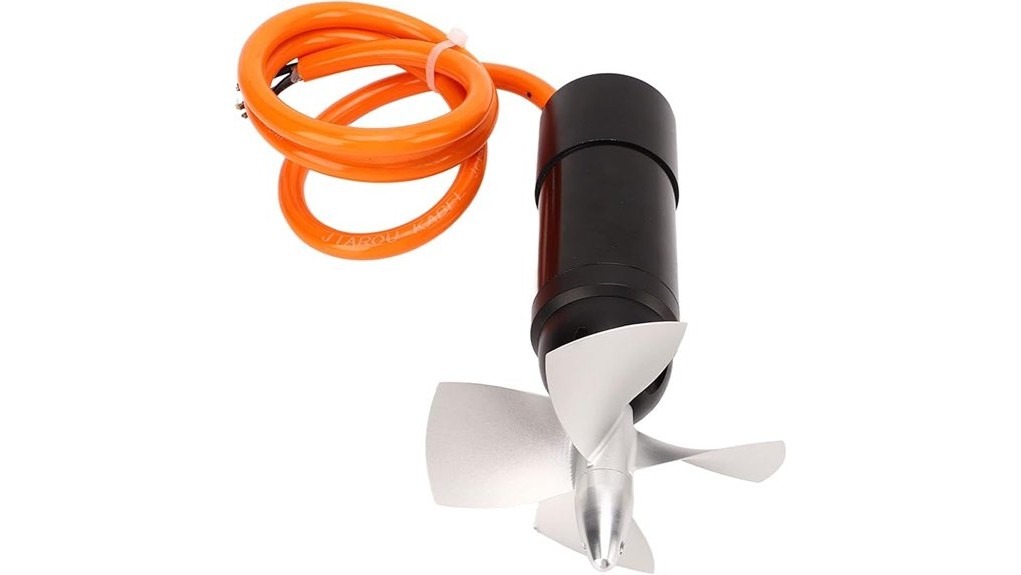
You’ll get a compact, serviceable brushless 4‑blade thruster that runs on 12–48 V, fits kayaks, ROVs and light boats, and delivers up to 18 kg thrust at 48 V under ideal conditions. It’s CNC 6061 aluminum with high‑purity copper windings for good heat transfer and predictable hydrodynamics, but expect higher cavitation noise at top speeds and significant current draw at high voltage. Match ESC, battery, wiring and mounts; continue for installation, tuning, and maintenance guidance.
Some Key Takeaways
- Compatible with 12–48 V systems; higher voltage yields more thrust but increases current draw and thermal stress.
- Peak efficiency occurs near mid-range RPM; log thrust versus input power to identify optimal operating point.
- CNC 6061 aluminum housing and copper windings offer corrosion resistance and good heat transfer, but inspect seals and anodizing.
- Requires external ESC/controller rated for continuous and burst currents, waterproofing, and appropriate interface (PWM, CAN, analog).
- Includes only the thruster; buy batteries, ESC, mounting hardware, and marine-grade connectors separately.
What the 12–48V Underwater Thruster Is and Who It’s For
The 12–48V Underwater Thruster is a brushless, 4-blade propeller motor assembly designed to provide efficient, high-thrust propulsion for small to medium watercraft and submersible platforms; you can install it on kayaks, underwater robots, unmanned or manned vessels, and electric water equipment that accept an external 12–48 V supply. You’ll find a CNC-machined 6061 aluminum housing, aluminum-alloy propeller, and high-purity copper windings built for durability. It’s sized and rated for retrofit or OEM use, weighing under 3 lb, and suits marine commuters and recreational explorers seeking a compact, serviceable propulsion module that integrates with existing 12–48 V systems. It is an ideal accessory for propeller kayak gear enthusiasts looking to upgrade or customize their watercraft.
Performance in Practice: Thrust, Efficiency, Heat and Impact Resistance
While you push the thruster through realistic loads, you’ll see its design deliver up to the stated 18 kg of thrust at 48 V under ideal conditions, with thrust falling predictably as voltage and current are reduced. You’ll measure propulsive efficiency by logging thrust versus input power across 12–48 V, noting peak efficiency near mid-range RPM. Heat is managed effectively; monitor winding temperature and motor controller for thermal limits. Impact resistance performs well in shallow collisions, but verify mounting. Watch for increased cavitation noise at high speeds and make certain proper controller integration to optimize torque curves and prevent abrupt voltage sag. This makes the unit a solid choice for kayak transducer arm setups where reliable propulsion integrates with accessory mounting.
Build, Materials, and Durability: 6061 Aluminum, Copper Coils, and 4-Blade Propeller
Solid construction shows through in the thruster’s CNC-machined 6061 aluminum housings, aluminum-alloy 4-blade propeller, and high-purity copper windings, giving you a durable, corrosion-resistant assembly optimized for underwater use. You’ll appreciate precise tolerances that reduce crevice corrosion risk and allow predictable hydrodynamic performance. Materials enable efficient heat transfer from copper coils to aluminum shell, supporting sustained operation. Corrosion testing should verify anodizing integrity and fastener compatibility; perform salt-fog and immersion checks. For operational validation, run a noise assessment at different RPMs to detect bearing or cavitation signatures. Maintenance focuses on seal inspection, propeller damage checks, and coil insulation integrity. Many paddlers also rely on quality gel coat restorers to maintain finish and protect exposed surfaces after saltwater excursions.
Power, Compatibility, and Installation Tips for Kayaks, ROVs, and Boats
Because this thruster accepts 12–48 V and draws significant current at higher voltages, you’ll need to match your power source, wiring, and controller to its voltage range and expected amperage to guarantee reliable operation. Size cabling for peak current, use marine-grade connectors, and fuse close to the battery. For battery integration, prefer high-discharge lithium or properly rated lead-acid banks with a BMS and voltage sag margin. Select an ESC or motor controller with appropriate continuous and burst current ratings and waterproofing. Implement standardized control interfaces (PWM, CAN, or analog) and secure mounts that isolate vibration and assure prop clearance. Consider adding essential safety and convenience accessories commonly sold for kayaks and bilge systems, such as marine-grade pumps, to enhance on-water readiness.
Buying Checklist: When to Choose This Thruster and What’s Included/Not Included
When selecting this 12–48V underwater thruster, match your vessel’s voltage and current capabilities, mounting constraints, and thrust requirements—it delivers up to 18 kg at 48 V but will draw substantially more current at higher voltages, so confirm your battery, wiring, and ESC are rated accordingly. Choose it if you need compact high-thrust duty, CNC 6061 housings, aluminum 4-blade propeller, and robust copper-wound motor for efficient continuous use. Included: single thruster unit; additional accessories unspecified. Not included: batteries, ESCs, mounting hardware, or spare components—you’ll procure those. Check seller warranty, voluntary 30-day returns, and shipping policies before purchase. Also consider carrying essential deck line replacement gear for safer mounting and handling on-water operations, such as gloves and replacement lines for safer kayak deck line replacements.
Some Questions Answered
Is This Thruster Waterproof Rated (Ip Rating) and Depth-Rated for Diving?
No — the listing doesn’t specify an IP rating or a formal depth tolerance, so you can’t assume water ingress protection for diving. You should treat the thruster as waterproof for surface or shallow submersion only, based on CNC aluminum housing and sealing claims. For reliable depth-rated use, request manufacturer test data (IP code, pressure/depth certification) and specified depth tolerance; otherwise, plan external pressure housings or professional potting to prevent water ingress.
What Connector Type and Wiring Length Are Provided With the Thruster?
It uses a Two pin connector and ships with a Custom cable length specified by the seller. You’ll receive a single power lead terminated in a Two pin connector compatible with standard marine thruster controllers; ground and positive conductors are present. Cable length isn’t fixed—order options or request a Custom cable length to match your installation. Confirm exact length and connector pinout with the seller before purchase to guarantee compatibility and proper sealing.
Are Spare Propellers or Replacement Parts Available From the Manufacturer?
The manufacturer doesn’t list spare availability for propellers or replacement parts directly, so you’ll need to contact the seller for official spares or warranty replacements. You can also source third party parts—identical aluminum 4-blade props and compatible seals/motors—from marine suppliers, but you’ll have to verify fit, balance, and corrosion resistance. Keep records and photos when ordering spares to make certain compatibility and to support any warranty or return claims with the seller.
Does the Thruster Include or Support a Built-In Motor Controller/Esc?
No, the thruster doesn’t include an internal controller; it requires an external ESC. You’ll connect your own motor controller via the provided power and signal leads, ensuring the controller supports the 12–48 V range and the motor’s current draw. Throttle interface is external and depends on your ESC—PWM, analog, or CAN—so you’ll choose a controller with the appropriate throttle interface and protections for underwater operation.
What Shipping Restrictions or Hazards Apply for International Orders?
You’ll face restrictions: the thruster’s metal motor and electronics can trigger hazardous packaging rules for batteries and electronic equipment, so carriers may require specific labeling, packaging, and documentation. You’ll need customs compliance for parts, declared value, and HS codes; some countries restrict import of propulsion or military-capable gear. Check carrier export controls, local import permits, and provide detailed specs to avoid delays. Contact seller for shipping certification and declarations.