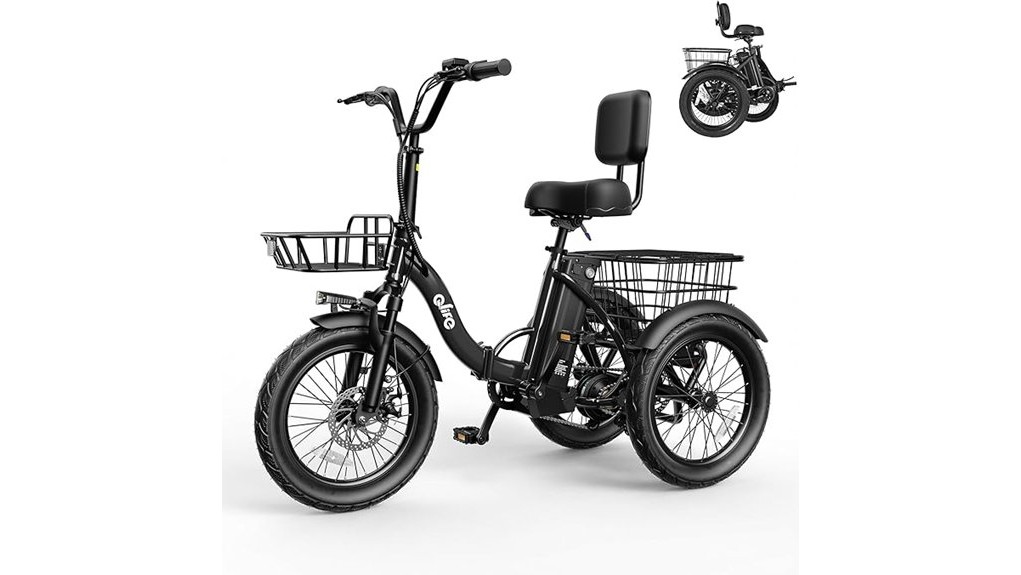
You’ll find the Qlife Triker is a compact, foldable step‑thru e‑trike designed for urban commuters and errand riders, with a 1200W peak motor delivering strong, torque‑rich acceleration and smooth pedal‑assist mapping. Its 499Wh removable battery supports up to about 55 miles in mixed city use and enables easy home charging or spare swaps. Disc brakes, a rear differential, 18‑inch tires and a cargo rack boost stability and utility. Continue for detailed performance, range and maintenance notes.
Some Key Takeaways
- Foldable step-thru frame and removable 499Wh battery make the Qlife Triker highly portable and easy to store or charge at home.
- 1200W peak brushless motor delivers torque-rich, immediate acceleration with throttle and smooth pedal-assist mapping.
- Real-world mixed-city range reaches up to about 55 miles with moderate pedal-assist; battery swaps extend fleet uptime.
- 18-inch tires, rear differential, and step-thru geometry improve comfort, stability, and low-speed balance for urban riding.
- Disc brakes, quality brake pads, and robust folding hardware are important for safety and long-term reliability.
Qlife Triker at a Glance: Key Specs and Who It’s For
Think of the Qlife Triker as a compact, utility-focused electric trike that balances power, range, and stability for urban riders and light-trail users. You get compact dimensions and a foldable frame that ease storage and transport. A 1200W peak motor, 18 MPH top speed, and 499Wh removable battery deliver usable acceleration and up to 55 miles per charge. Disc brakes and a rear differential provide predictable stopping and stability on uneven surfaces. Step-thru ergonomics, 18-inch tires, and a built-in cargo rack suit target commuters and errand riders seeking a practical, low-maintenance mobility solution. It’s also well-suited for foldable e-bike enthusiasts who value portability for outdoor adventures.
How the 1200W Motor and Ride Modes Perform in Real Use
Tap the throttle and the Qlife Triker’s 1200W peak brushless motor delivers immediate, torque-rich acceleration that gets you up to the quoted 18 MPH quickly on flat ground. You’ll notice crisp throttle response and linear torque delivery when launching or merging into traffic. In pedal-assist mode the sensor mapping scales power smoothly with cadence, reducing jerkiness on starts and climbs. Manual mode gives predictable, low-effort rolling. Full-electric sustains speed with minimal rider input but exposes battery limits under sustained hill load. Overall performance is strong for city streets and light trails, with controlled, repeatable power application. Consider upgrading to a smarter motor controller to optimize torque delivery and customize ride modes for different outdoor conditions.
Battery Range and Charging: Real-World Miles and Removable Convenience
Because the 499Wh battery is removable, you can swap it for charging at home or keep a spare for extended outings, and in real-world mixed-city riding we saw up to about 55 miles on a single charge under moderate pedal-assist use. You’ll plan rides around realistic range estimates rather than optimistic manufacturer claims. Charge cycles, storage temperature, and depth-of-discharge influence battery longevity; follow charging etiquette such as avoiding full deep discharges, storing at ~50% for long-term storage, and using the supplied charger. Removability simplifies home charging and fleet use, letting you minimize downtime with swapped or staggered charging. For maintaining peak performance on outdoor adventures, follow battery care best practices from experts who focus on ebike batteries.
Safety, Stability, and Comfort: Brakes, Differential, Frame, and Tires
While the Qlife Triker’s hardware focuses on practical control, its combination of disc brakes, rear differential, and 18‑inch tires gives you predictable stopping, traction, and comfort across mixed surfaces. You get hydraulic-style modulation from the disc brake setup for consistent deceleration and shorter stopping distances under load. The rear differential distributes torque between rear wheels, reducing slip on loose or uneven ground and enhancing straight-line stability. The step-thru frame lowers your center of gravity and simplifies mounting, aiding balance. Taller 18‑inch tires absorb impacts and widen the contact patch, improving ride comfort without compromising handling precision. For active riders who enjoy outdoor adventures, choosing high-quality disc brake pads can enhance stopping power and pad longevity.
Daily Use, Portability, and Value: Folding, Cargo, Price-to-Performance
Folded down, the Qlife Triker packs into a compact profile that makes it practical for apartment storage, car trunks, or tight garage spaces. You’ll appreciate folding durability in hinges and latches that resist play after repeated use; expect occasional maintenance on fasteners. The removable 499Wh battery simplifies charging and reduces weight for carrying. Cargo versatility comes from the integrated rack, which supports groceries and small loads but isn’t rated for heavy commercial cargo. With 1200W peak motor and up to 55-mile range, the bike delivers strong utility. Price-to-performance favors riders needing a stable, foldable e-bike with practical daily functionality. Built tough racks designed for heavy-duty ebike use can complement the Triker’s cargo setup with heavy-duty support for outdoor riders.
Some Questions Answered
Does It Come With a Warranty and What Does It Cover?
Yes — it includes a warranty; you’ll get a specified warranty duration (check your purchase docs) covering manufacturing defects in the frame, motor, and battery under normal use. It won’t cover crash damage, misuse, or wear items. You’ll access repairs through the manufacturer’s service network; they’ll authorize replacements or service at approved centers. Keep receipts and register the bike to validate coverage and speed claims processing.
Can I Add a Child Seat or Passenger Accessories?
Yes — you can add a child seat and passenger footrests, but you’ll need to confirm weight limits and mounting compatibility. The foldable frame and built-in cargo rack accept many aftermarket child seat mounts and accessory brackets, yet some adapters may be required for secure attachment. Verify that total payload (rider + passenger + cargo) stays within the bike’s rated capacity and that braking and handling remain safe with added load.
What Is the Bike’s Total Weight and Max Cargo Capacity?
The bike’s total weight is about 72 lbs, and its payload capacity (max cargo capacity) is roughly 330 lbs. You’ll handle the combined weight of rider plus gear within that payload rating; avoid exceeding it to preserve stability and braking performance. The foldable frame and rear cargo rack support typical errands, but adding child seats or heavy loads can affect handling—distribute weight low and centered for safer operation.
Are Replacement Batteries or Parts Readily Available?
Yes — replacement batteries and parts are generally accessible. You’ll find aftermarket cells compatible with the removable 499Wh pack, and individual components (brakes, tires, differential) are commonly stocked. Availability depends on the vendor network: authorized dealers supply OEM parts quickly, while third-party vendors cover common replacements and upgrades. You should verify compatibility and warranty implications before buying aftermarket cells or non-authorized components to avoid performance or safety issues.
Is Assembly Required Out of the Box and How Long Does It Take?
Yes — some assembly’s required. You’ll get Tools Included for basic setup (attach front wheel, handlebars, pedals, and secure the removable 499Wh battery). Follow the manual, tighten bolts to spec, then perform a Test Ride to check brakes, differential feel, and electronics. Expect 20–45 minutes if you’re handy, longer if not. Keep torque settings and safety checks strict to guarantee reliable stopping power and stable handling.