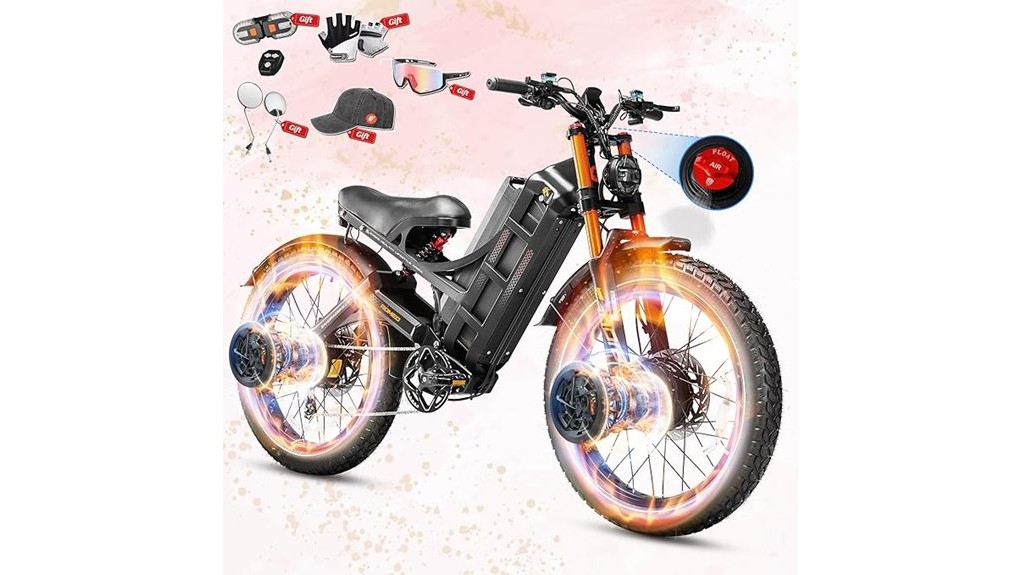
You’ll get a heavy-duty, long-range dual-motor e-bike that delivers brisk, sustained thrust—up to 5,600W peak and 150 N·m—with crisp mode shifts and predictable shifter/pedelec integration. Its 4,800 Wh (60V/80Ah) pack supports roughly 200–235+ miles depending on load and riding mode, and thermal-managed dual controllers plus robust suspension and 500 lb-rated frame handle cargo or big riders. Brakes, fail-safes, and app diagnostics keep things practical, and the following sections outline best-use configs and trade-offs.
Some Key Takeaways
- Powerful 5600W peak dual-motor system delivers strong, linear 150 N·m torque with minimal lag and smooth mode transitions.
- 4,800 Wh (60V/80Ah) battery supports 200–235+ mile range; 67.2V 7A charger recommended for overnight charging.
- Reinforced steel frame, upgraded hubs, and full suspension support a recommended 500 lb load for cargo and riders.
- Dual hydraulic disc brakes, P-mode start lockout, ambient sensors, and fail-safe dual controllers enhance safety and diagnostics.
- Best suited as a heavy-duty commuter or cargo workhorse; 52V/70Ah option reduces weight and cost with shorter range.
Real-World Performance: Speed, Torque, and Riding Modes Tested
Push the Romeo Pro and you’ll feel the 5600W peak dual-motor system and 150 N·m torque translate into immediate, sustained thrust across all four riding modes. You notice torque delivery is linear under load, with minimal lag from standstill and firm midrange pull that sustains up to top speed. Mode transitions are crisp: front or rear-only feel isolated, dual blends smoothly for steady acceleration, and super dual releases max output without hesitation. Your shifter and pedelec assist integrate predictably, letting you manage power across seven gears. Overall, acceleration and control align with the bike’s claimed performance metrics. This makes the Romeo Pro a compelling choice for adventure riders seeking robust, motor-focused performance.
Battery, Range, and Charging : What to Expect on Long Trips
After confirming the Romeo Pro’s power delivery, you’ll want to know how the battery supports long rides. The 60V/80Ah pack stores 4,800 Wh, delivering the stated 200–235+ mile range depending on load and mode; use conservative range estimation for planning. Charge with the 67.2V 7A charger overnight, follow charging etiquette—avoid topping to 100% constantly and balance cells via the BMS. Thermal management matters: dual controllers rated to 120°C and BMS protect longevity during sustained high loads. For extended tours consider pack swapping or the 52V alternative and map charging opportunities to minimize downtime. Consider carrying a spare pack or accessories from our spare ebike batteries selection to extend rides and reduce range anxiety.
Build, Suspension, and Load Capacity for Heavy Riders and Touring
Because the Romeo Pro’s reinforced carbon-steel frame, upgraded wheel hubs, and thicker spokes are engineered to handle a 500 lb recommended load, you can plan heavy-rider use and loaded touring without overstressing the chassis. You’ll benefit from focused frame reinforcement that transfers loads to reinforced rims and larger hubs, reducing flex under weight. The full suspension—dual-shoulder air front and adjustable rear shock—lets you fine-tune rebound for cargo and rider mass, preserving control and comfort. Paired with 26×4.0 fat tires featuring double rubber layers and stronger liners, Tire longevity improves under touring conditions and rough surfaces. Perfecting wheel setup and truing can further extend rim and tire life by keeping loads distributed evenly across the spokes and bearings, which is especially important for ebike wheel truing.
Safety, Brakes, and Smart Controls : Daily Usability Review
While riding the Romeo Pro you’ll immediately notice how its safety systems and controls prioritize predictable, confidence-inspiring operation, combining robust hardware with smart redundancy. You get dual oil-cup hydraulic discs and oversized rotors that stop decisively, with P-mode start and a lockout mechanism to prevent accidental engagement. Ergonomic switches place mode and brake feel at your fingertips, and ambient sensors adjust lighting and power delivery in real time. Dual controllers plus fail safe diagnostics give layered protection, alerting you through the color LCD and app. Daily usability is practical: intuitive, tough, and engineered to reduce surprise and maintenance. For active riders who often tackle steep trails and variable conditions, choosing the right disc brake pads can make a significant difference in stopping power and durability.
Value Verdict: Who Should Buy the Romeo Pro and Which Configuration to Pick
If you want a heavy-duty, long-range e-bike that doubles as a utility vehicle, the Romeo Pro delivers exceptional value for riders who need raw power, load capacity, and extended range without constant maintenance. You should buy it if you need a commuter bargain that also serves as a cargo utility workhorse—dual motors, 4,800 Wh battery, and 500 lb capacity make it ideal. Choose the 60V/80Ah for true long haul range; opt for the lighter 52V/70Ah if you prioritize weight and cost. For adventure touring pick dual-drive with reinforced suspension and fat tires for versatility and reliability. Many riders pair these bikes with heavy-duty ebike racks to maximize cargo capacity and rugged utility.
Some Questions Answered
Does the Romeo Pro Support Regenerative Braking?
Yes — the Romeo Pro supports regen braking. You’ll get regen braking that assists deceleration and enables energy recapture into the 60V battery system, improving range slightly. It pairs with dual controllers and hydraulic brakes for controlled recovery, and the BMS manages returned charge to protect battery life. You’ll notice smoother braking feel in certain modes; check the app or display to confirm regen settings and real-time energy recapture feedback.
Is the Battery Removable for Airline or Storage Rules?
No — the battery isn’t designed for easy battery removal for airline compliance. You’ll find a large 60V/80Ah pack integrated into the frame with high energy (4,800 Wh), making it impractical and noncompliant with most airline limits. For storage, you can disconnect and follow BMS guidelines, but you shouldn’t expect a quick remove-and-carry option. Contact the manufacturer for certified battery removal or alternative lower-capacity packs for travel.
What Accessories or Cargo Racks Are Compatible?
You can fit a sturdy rear rack and a front basket for cargo; you’ll want racks rated for the 500 lb max load and fat‑tire frames. Choose reinforced rear racks with wide mounting plates and multiple eyelets, and a robust front basket that clamps to the headtube or fork crown. Use vibration‑damping mounts, oversized bolts, and check spoke clearance. Prefer racks tested for e‑bikes and cargo, and follow torque specs.
Are Replacement Parts Readily Available After Warranty?
Yes — spare availability is generally good, but it varies by part. You’ll find common wear items (brakes, tires, tubes, suspension seals, batteries, controllers) through the manufacturer, aftermarket suppliers, and online parts sourcing marketplaces. You should expect longer lead times for proprietary items like the dual controllers or specific frame components. Keep originals and record serials; that speeds replacement. Consider stocking high-wear spares to minimize downtime.
Can It Be Converted to a Throttle-Only Electric Bike?
Yes — you can convert it to throttle-only, but you’ll need to modify controls and respect local laws. You’ll swap the pedelec wiring for a thumb throttle or half twist throttle, reconfigure the dual controllers for continuous throttle input, and make certain the BMS and P-mode safety start won’t block operation. Have a skilled e-bike tech do the install, verify brake cutoffs, and keep firmware/settings aligned to prevent faults or voiding warranty.